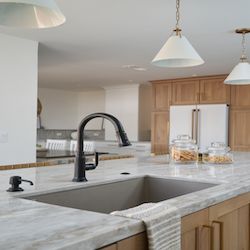


San Diego Marble & Tile offers a wide range of engineered countertop materials, including quartz, porcelain slabs, and more. Below are answers to our most frequently asked questions. For detailed care instructions, see our Stone Countertop Maintenance Guide.
1. How often should I seal my natural stone countertops?
Sealing protects porous natural stones from stains and damage.
- Quartzite: About once a year (varies by usage and specific stone type).
- Marble & Limestone: Every 6–12 months for optimal protection. Tip: Perform the water drop test—if water no longer beads up and instead absorbs/darkens the surface within minutes, it’s time to reseal. See our full maintenance guide for products and tips.
2. Do quartz countertops need to be sealed?
No—quartz (engineered stone) is non-porous and does not require sealing. Clean with mild soap and water. Sealers are available for dark or matte finishes to ease cleaning, but they’re optional.
3. Can I put hot pots and pans directly on my countertops?
Use trivets or hot pads to be safe:
- Quartz: No—avoid direct heat over ~300°F, as resins can discolor or crack.
- Quartzite: Generally heat-resistant, but trivets recommended.
- Marble & Limestone: Handles moderate heat but risks thermal shock or etching from very hot items.
- Porcelain: Excellent heat resistance—many use it directly for induction or hot cookware.
4. What cleaners are safe to use on countertops?
- Natural Stone (Quartzite, Marble, Limestone): pH-neutral stone cleaners or mild dish soap and water. Avoid acidic cleaners (vinegar, lemon, bleach) as they can etch or dull surfaces. (Some embrace marble’s patina over time.)
- Quartz & Porcelain: Mild soap and water; avoid abrasives or harsh chemicals. These are very easy to maintain.
5. How do I prevent stains and etching on marble or limestone?
- Apply high-quality stone sealers regularly.
- Wipe up acidic spills (wine, citrus, tomato sauce) immediately.
- Use coasters for drinks and trays for toiletries.
- Reseal proactively to reduce absorption risks.
6. Can quartz countertops be used outdoors?
No—quartz is not UV-stable and may discolor or yellow in direct sunlight. For outdoor kitchens, choose porcelain slabs or quartzite instead.
7. What’s the estimated yearly maintenance cost for countertops?
- Natural Stone (Quartzite, Marble, Limestone): ~$100–$200/year (sealants, cleaners).
- Quartz & Porcelain: <$20/year (basic cleaning supplies only).
8. How do I know if my countertop needs resealing?
Use the water drop test: Place drops on the surface. If they absorb or darken the stone within minutes (instead of beading up), reseal promptly.
9. Is quartz easier to maintain than granite?
Yes—quartz is non-porous, stain-resistant, and requires no sealing. Granite is durable but typically needs sealing every 1–2 years to prevent stains. Quartz offers a natural stone look with far less upkeep..
10. What is the easiest countertop material to maintain?
Quartz and porcelain slabs are the easiest. Both are non-porous, resist stains/etching, and clean with mild soap and water—no sealing required. Ideal for busy households or rentals.
11. Do quartz countertops stain easily?
Quartz is highly stain-resistant due to its non-porous surface, but not 100% stain-proof. Promptly clean spills like coffee, wine, or markers to avoid marks.
12. Are porcelain countertops suitable for outdoor kitchens?
Yes—porcelain is UV-resistant, heat-resistant, non-porous, and low-maintenance. It holds up well outdoors without fading, unlike quartz.
13. Does marble require a lot of maintenance?
Yes—marble is stunning but more demanding. Seal every 6–12 months and protect from acids to prevent etching. Many love its developing patina; for lower maintenance, consider quartz or porcelain.
14. What are the key differences between quartz, quartzite, marble, and porcelain?
- Quartz (engineered): Non-porous, low maintenance, consistent patterns, no sealing.
- Quartzite (natural): Heat/durable like granite but often more stain-resistant when sealed; unique veining.
- Marble/Limestone (natural): Elegant, softer, porous—prone to etching/stains but develops beautiful patina.
- Porcelain (slabs): Extremely durable, UV/heat resistant, ideal indoors/outdoors, no sealing. Visit our showrooms or gallery to compare samples.
15. How can I get help with selection, installation, or care?
Our team works with contractors, designers, and homeowners. Contact our sales team, visit one of our Southern California locations, or check related resources like the Tile FAQ for complementary info.

SHOP HERE, PICK-UP THERE
With 4 showroom & warehouse locations across Southern California, you can now ‘Shop here, and Pick-up there’ — we have the reach and convenience to suit all our local customer’s needs — we are local.

WE STRENGTHEN YOUR TEAM
We work closely with your contractor & designer to ensure your project stays on schedule & your design concept becomes a reality for you to enjoy for many years. Think of us as part of your team.